
We have spent decades learning how to measure physical risk. Now we need to understand what that risk costs governments and what reducing it is worth.
Last week, I had the opportunity to speak at the Flow & Flourish conference, hosted by Floodplains by Design. The conversations were familiar to anyone working in this space: floodplain restoration, infrastructure investment, community engagement, partnerships, and the growing challenge of protecting communities from extreme weather.
We have become remarkably good at describing physical risk. We can model flooding down to individual properties, estimate future storm intensities, and identify infrastructure vulnerabilities with increasing precision. Yet we remain far less sophisticated at translating that information into the financial language governments use to make decisions.
That disconnect matters because resilience is not simply an environmental or engineering challenge. It is fundamentally a public finance challenge.
And I would argue that solving it could unlock substantially more investment than inventing another specialized financing mechanism.
The Government Is Already Paying for Resilience
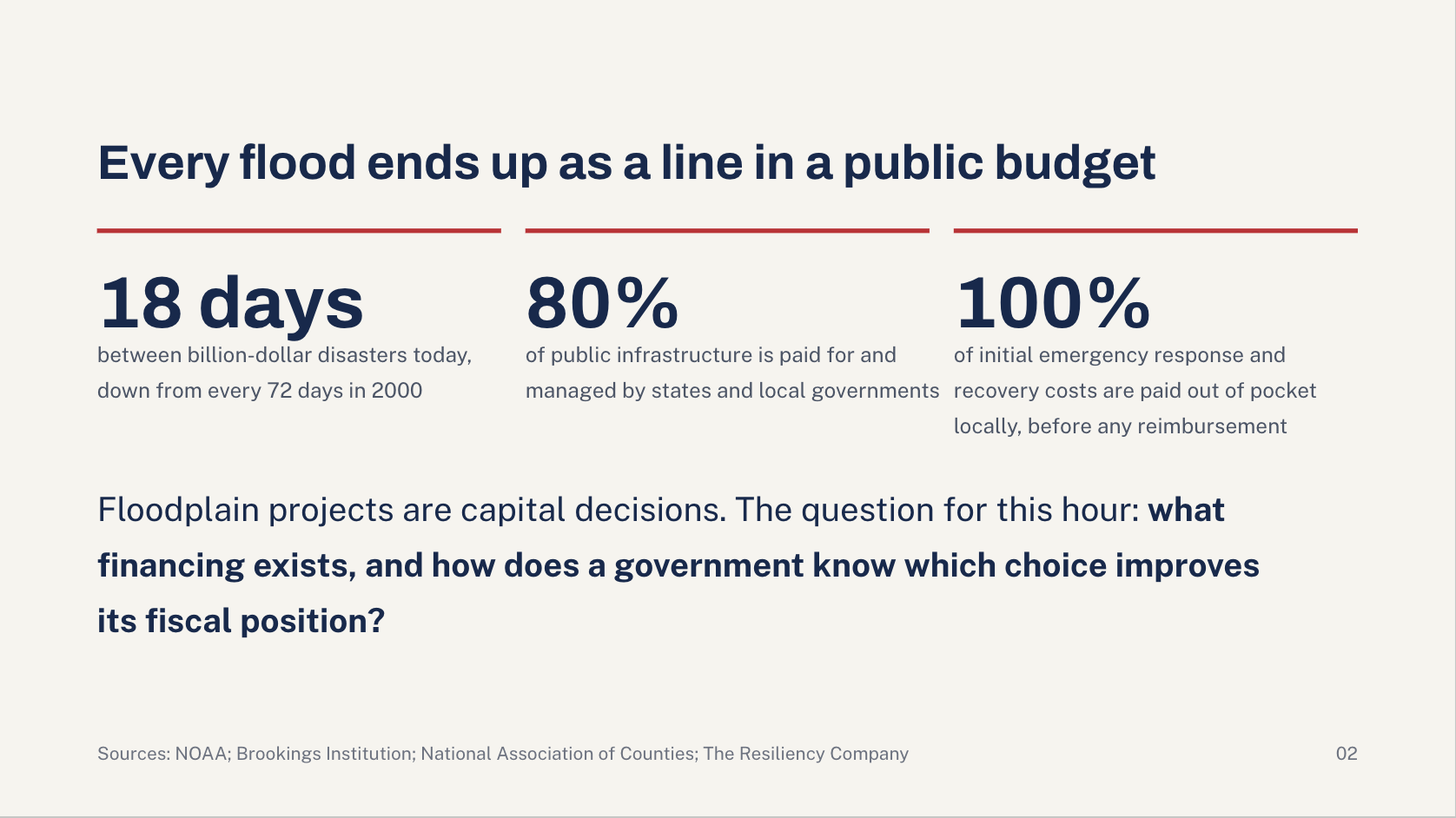
State and local governments finance and operate anywhere from 75% to 90% of America's public infrastructure depending on where you are. They also borrow hundreds of billions of dollars annually through the municipal bond market to finance roads, utilities, schools, and other public assets.
Meanwhile, extreme weather is creating growing financial pressure on those same governments.
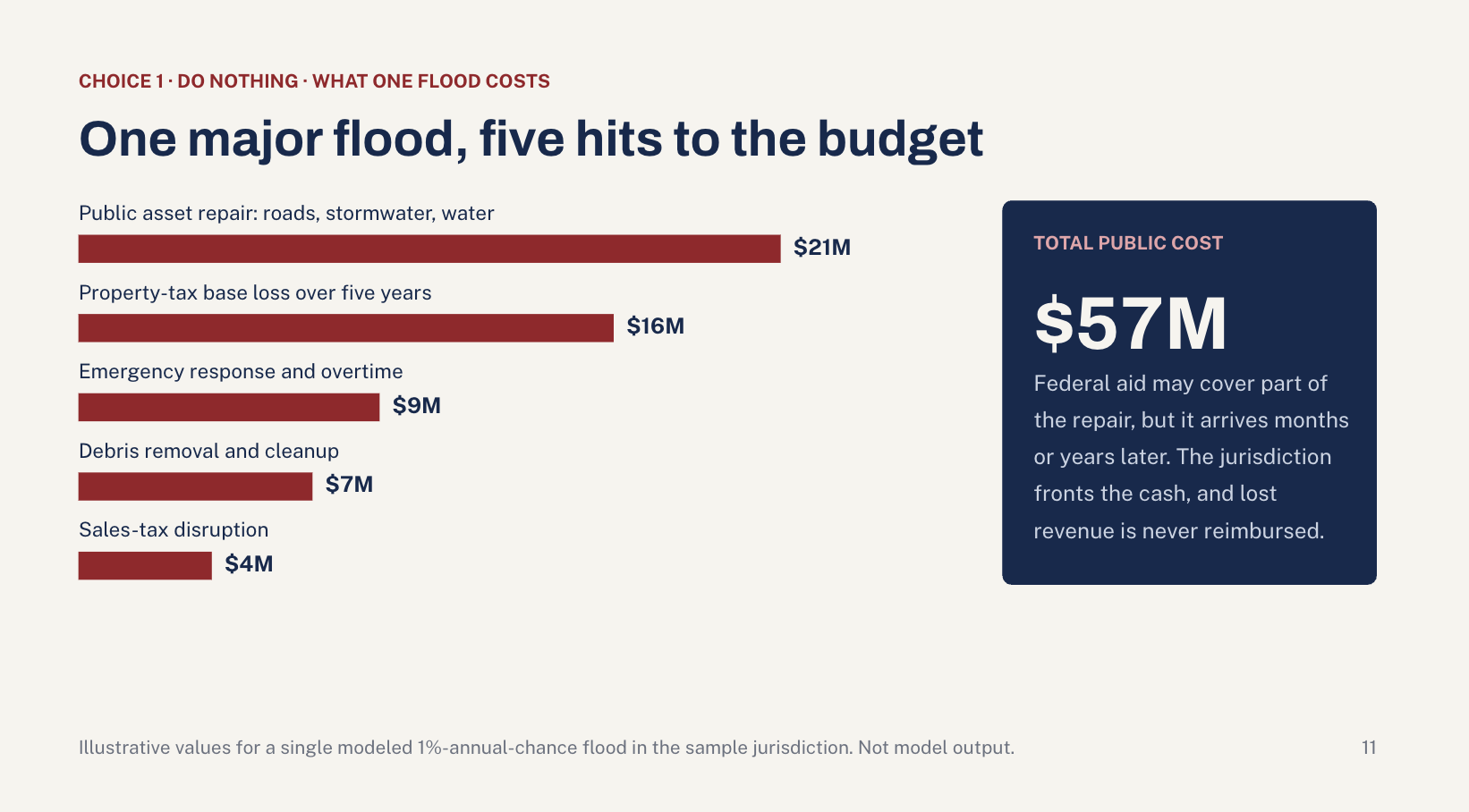
When a flood occurs, the financial consequences extend well beyond damaged infrastructure. Governments face emergency response costs, debris removal, interrupted economic activity, declining tax revenues, and potentially years of recovery expenditures. Federal disaster assistance may reimburse some eligible costs, but those funds often arrive well after local governments have incurred the expenses.
Every flood eventually becomes a line in a public budget.
The resilience community frequently approaches this challenge by asking how we can attract new sources of capital. We talk about blended finance, catalytic capital, impact investment, and innovative public-private partnerships. These approaches have their place. But having spent much of my career in public finance, I think we sometimes overlook a much larger opportunity.
Governments are already financing resilience. We simply do not consistently identify, measure, or value the resilience benefits of those investments.
A stormwater revenue bond can finance drainage improvements. A general obligation bond can fund infrastructure hardening. Special assessment districts can allocate costs among benefiting properties. State bond banks can aggregate smaller projects and reduce borrowing costs. These are not theoretical financing structures. They exist today, and taxpayers and ratepayers are already supporting them.
The challenge is making resilience a more deliberate part of how these financial decisions are made.
The Financing Architecture Already Exists
Consider municipal bonds. Their fundamental question is straightforward: what revenue will repay the debt? For resilience projects, that question becomes particularly interesting because the benefits of an investment rarely stop at the government's balance sheet. A floodplain restoration project may reduce municipal infrastructure losses, but it can also protect private property, lower insurance exposure, preserve mortgage collateral, improve water quality, and protect businesses from disruption.
Who should pay for those benefits?
Historically, governments have been expected to shoulder much of the responsibility, even when the financial benefits extend to numerous private actors. This is where I see one of the greatest opportunities for resilience finance.
If we can quantify how much risk reduction benefits each participant, we can begin designing financing arrangements around those benefits. Utilities might contribute through their capital programs. Property owners might participate through assessments. Insurers, lenders, employers, and philanthropic organizations might support projects that demonstrably reduce their exposure or advance their objectives.
Resilience districts, state revolving funds, and public-private partnerships can help organize those arrangements. But creating a new financing vehicle does not, by itself, create economic value or a revenue stream.
We must first establish what an investment is worth, to whom, and why.
Four Choices Every Government Is Already Making
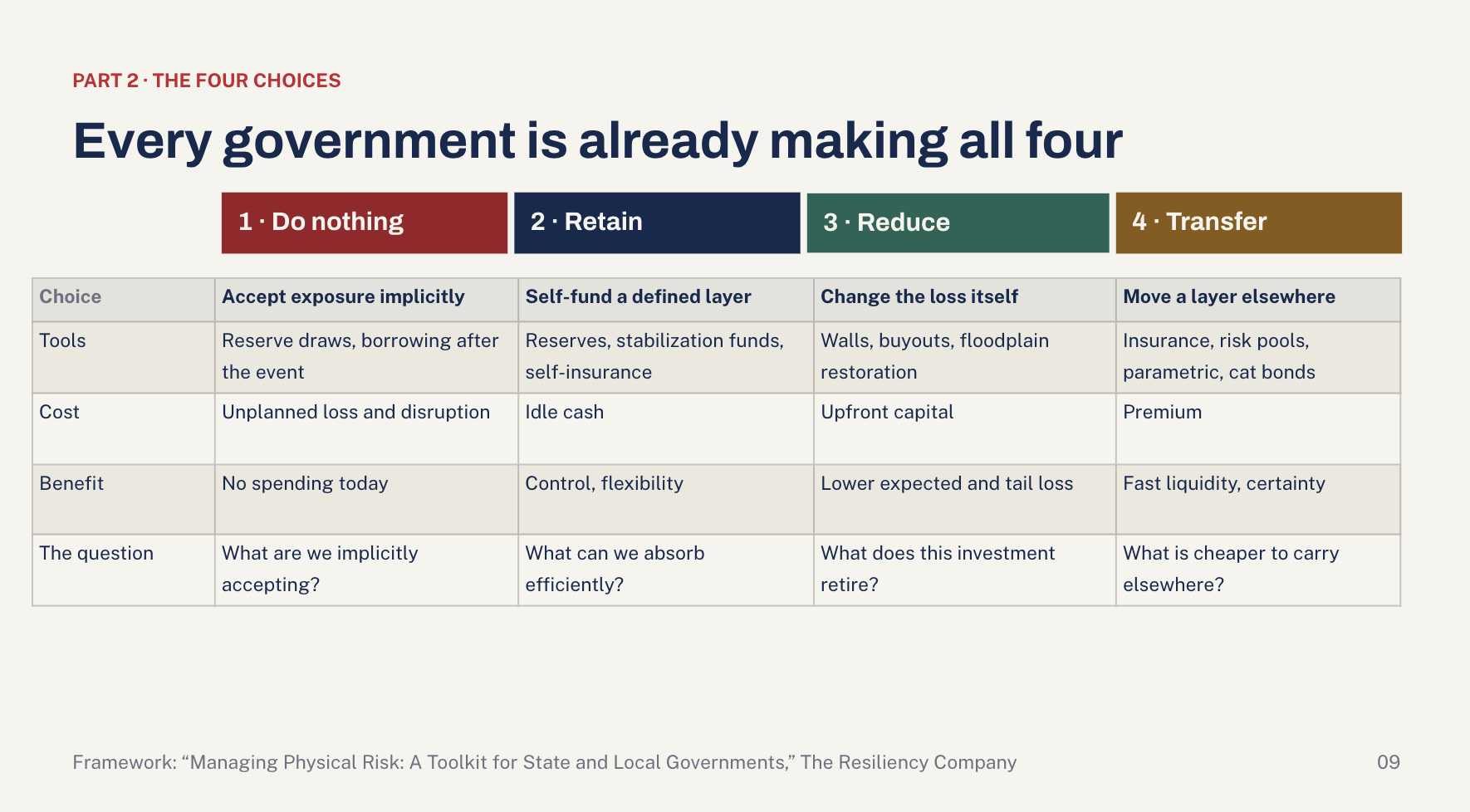
At The Resiliency Company, our Resilient America initiative approaches this challenge through a framework that is familiar in risk management but insufficiently integrated into public finance. Every government has four choices when confronting physical risk:
Do nothing: Accept exposure and absorb the consequences when an event occurs.
Retain: Set aside reserves or other financial resources to absorb future losses.
Reduce: Invest in infrastructure, land use, building standards, or other interventions that reduce the underlying risk.
Transfer: Move a portion of the financial exposure to insurers or capital markets.
Most governments already employ some combination of these approaches. But they rarely evaluate them together using a common financial methodology. Doing nothing, for example, is not free. It is effectively an implicit decision to self-insure against an exposure that may not be fully understood.
Likewise, holding additional reserves is not automatically the best answer. Reserves provide essential liquidity and financial stability, but beyond a certain point, additional dollars may provide diminishing protection against a particular modeled risk. At what point would investing those resources in mitigation produce a better financial outcome? And when does transferring a layer of catastrophic risk through insurance make more sense than retaining it? These are questions governments should be able to answer quantitatively.
Translating Physical Risk Into Fiscal Risk
This is why we developed the RiskReserves Tool (RRT). Rather than starting exclusively with a hazard map, RRT begins with a government's financial position: revenues, expenditures, reserves, and financial policies. It incorporates physical hazards and economic shocks into thousands of simulated financial futures. The objective is to answer questions that finance officers and elected officials already ask.
How much should we maintain in reserves? What is the probability of falling below a critical financial threshold? Which hazards create the greatest exposure? How might a recession compound the financial consequences of a natural disaster?
The initial application is risk-informed reserve planning. But the broader opportunity is considerably more powerful. Once a government can quantify physical risk in budget terms, it has a foundation for evaluating investments intended to reduce that risk.
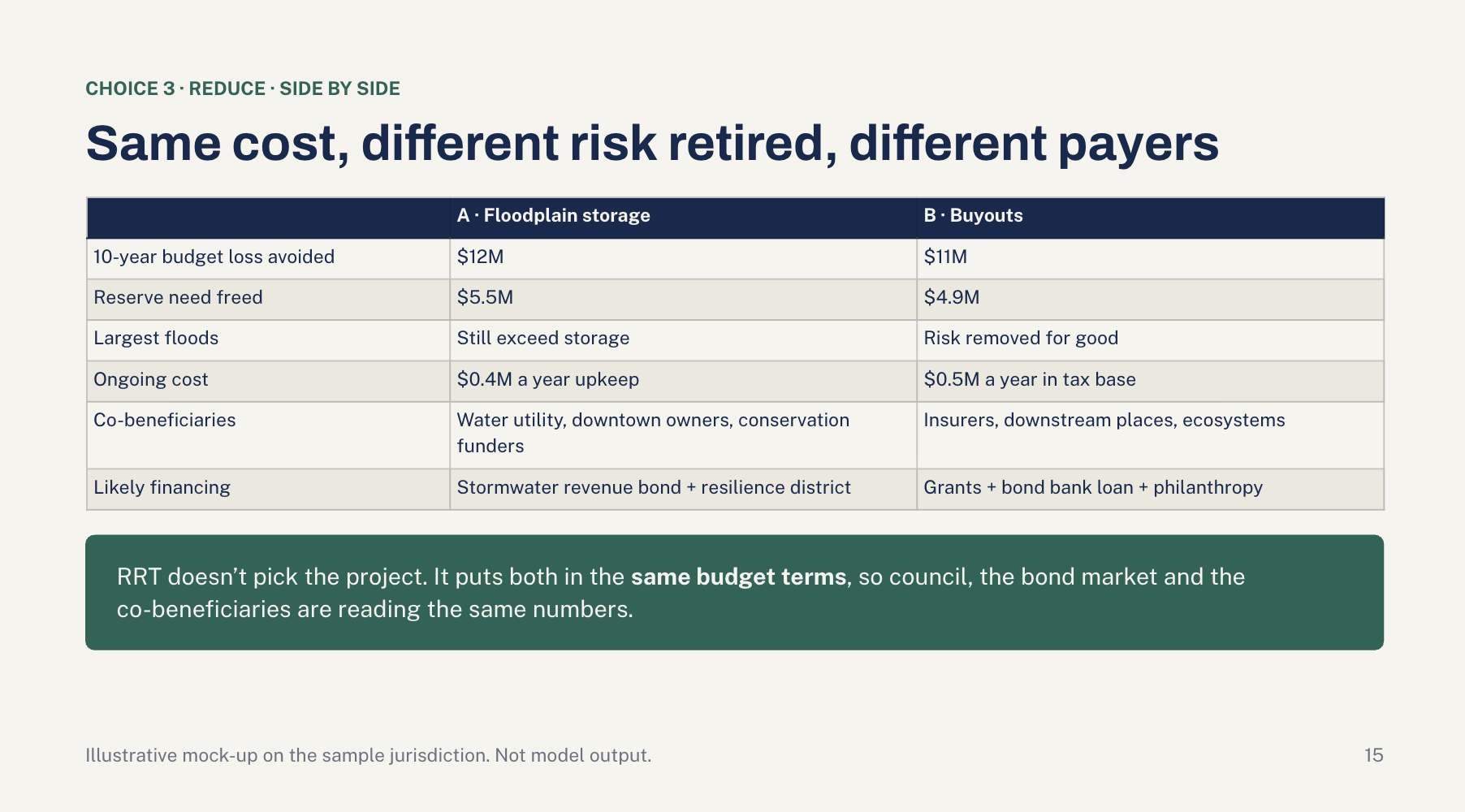
Consider two hypothetical $45 million investments: reconnecting a floodplain to provide additional water storage and purchasing repeatedly flooded homes through voluntary buyouts.
Both might reduce flood exposure, but they create different financial outcomes. Floodplain storage may reduce expected losses while requiring ongoing maintenance. Buyouts can permanently eliminate exposure for participating properties, but may also reduce the local property-tax base. Each intervention also creates benefits for different stakeholders.
A traditional engineering analysis can help establish how these projects perform physically. A fiscal risk analysis can add another dimension: how do they change future expenditures, revenue exposure, reserve needs, and financial stability? Neither analysis replaces the other. Together, they provide a much stronger basis for investment decisions and for identifying who might help finance them.
From Individual Projects to a National Investment Strategy
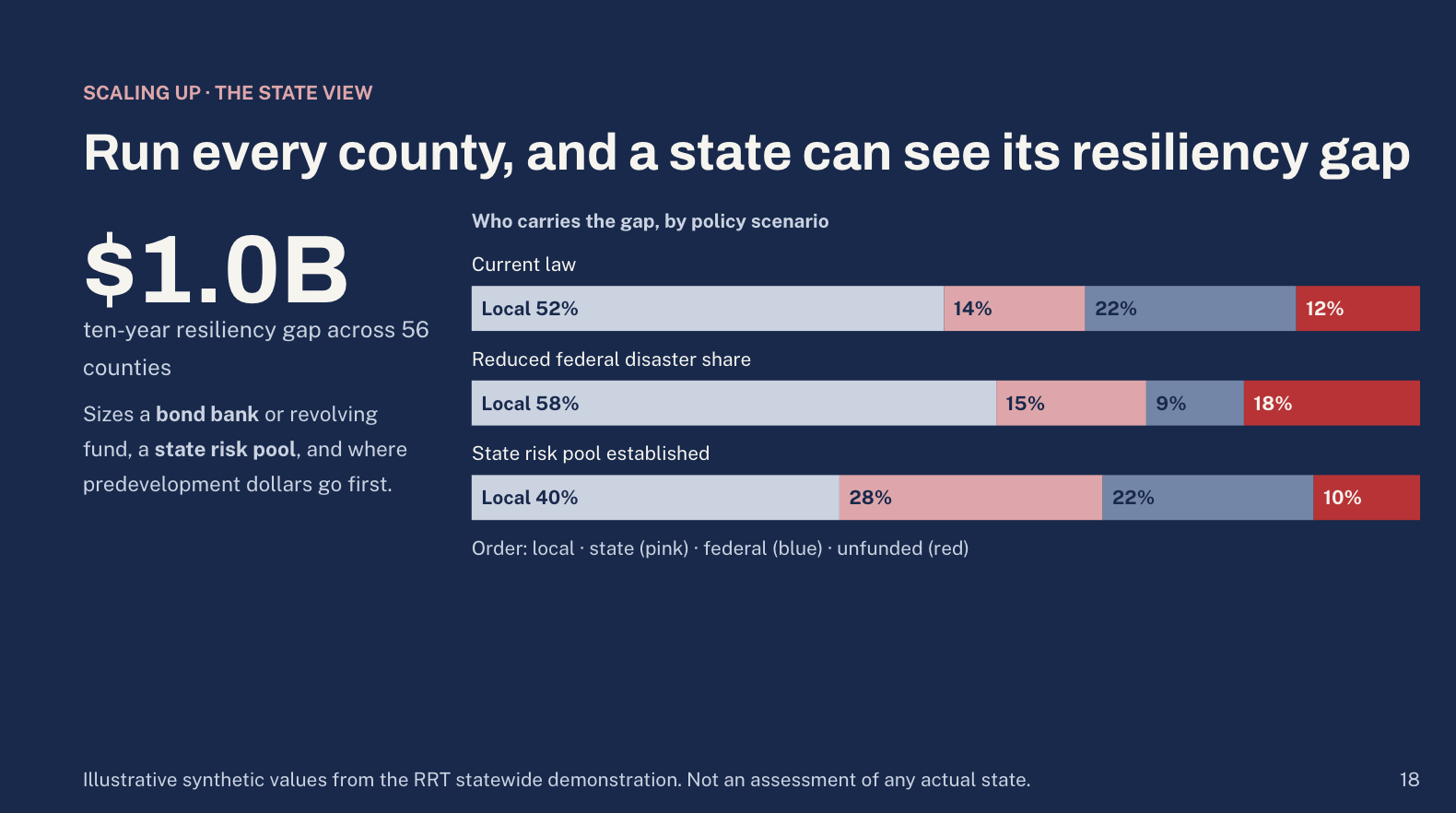
Now imagine applying this approach across an entire state. Instead of evaluating resilience investments primarily through individual grant applications, a state could develop a consistent picture of the financial risks facing its counties and municipalities. That information could inform where a state bond bank directs capital, how a revolving fund establishes priorities, where predevelopment assistance is most valuable, and whether a statewide insurance pool could improve financial protection. It could also help policymakers understand the consequences of changes in federal disaster assistance and determine where state resources would have the greatest impact.
The same approach could inform building standards and retrofit incentives. If stronger construction reduces future public expenditures and financial exposure, governments have a clearer rationale for encouraging or financing those improvements. This is how resilience moves from a collection of individual projects into a systematic component of public financial management.
The Great Unlock
I often hear that governments simply do not have enough money to invest in resilience. It is true that budgets are constrained, infrastructure needs are enormous, and competing priorities are real. But this is a viewpoint contingent with resilience not being part of everyday operations.
I think we should challenge the assumption that resilience must depend primarily on new discretionary appropriations or philanthropic subsidies. America already has an extraordinary public finance system. Governments already make decisions about infrastructure investment, reserves, borrowing, insurance, and economic development every day.
What has been missing is a consistent way to incorporate the financial consequences of physical risk into those decisions. And once we can quantify the value of risk reduction to the public balance sheet, we can begin identifying the value it creates for private balance sheets as well. This is embedding resilience into public policy.
That is the opportunity behind Resilient America: helping governments lead, giving them better financial information, and organizing capital around investments that produce measurable benefits. We do not need to invent an entirely new financial system for resilience. We need to make the existing one work more intelligently.
Doing nothing is already a choice. The next step is making sure governments can measure it against the alternatives.
