
A ballot question in NYC and a few other governments around the country has implications for the resilience industry.
Key Takeaways
More governments are putting their rainy day funds to a public vote, with New York City, California, Florida and Snohomish County all on Tuesday’s ballot.
A fixed percentage of revenue is a starting point, but the right reserve level depends on the specific risks a government faces, including extreme weather.
Once a government can put a dollar figure on its risks, it can compare holding reserves, investing in mitigation and buying insurance using the same numbers.
How Much Should New York City Save for a Rainy Day? Voters Are Being Asked to Decide.
On November 3, New York City voters will weigh in on what looks like a simple matter: how much money a government should set aside for a rainy day.
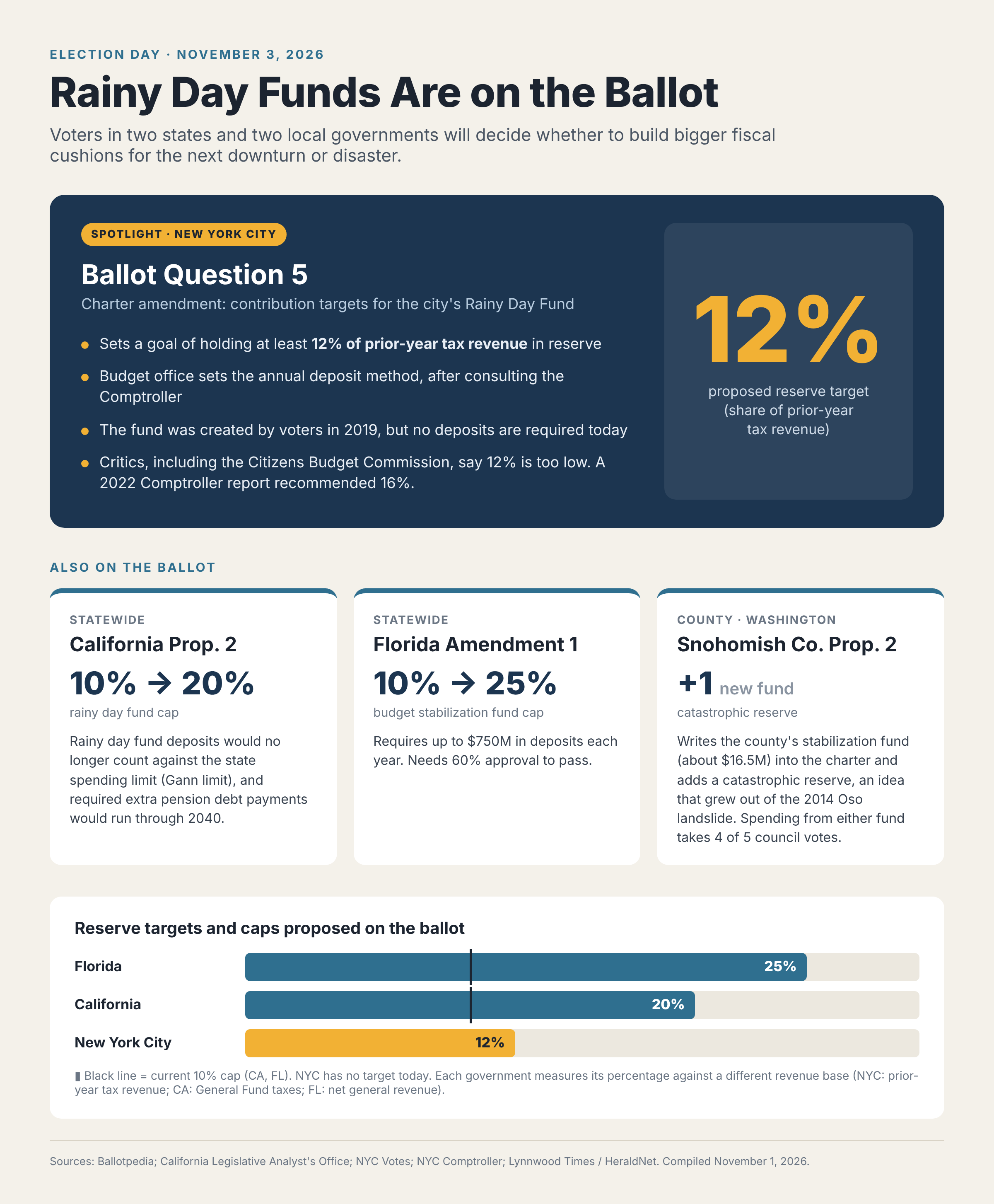
Ballot Question 5 would set a target for the City’s rainy day fund equal to 12% of the previous year’s tax revenue. It would also require the City to develop a method for making regular contributions to the fund. That is a significant step for a city that, until 2019, could not even keep a traditional rainy day fund because of financial management rules dating back to its 1970s fiscal crisis.
New York is not alone. California voters will consider raising the cap on the state’s rainy day fund from 10% to 20% of General Fund taxes. Florida voters will consider raising the cap on its budget stabilization fund from 10% to 25% of net general revenue. The measures differ, but all three reflect a growing focus on how governments prepare financially for an uncertain future. The image below summarizes the reserve measures on this year’s ballot.
These proposals also highlight a harder issue: knowing how much a government actually needs to save.
For decades, governments have relied on reserve policies that set minimum balances as a percentage of revenues or expenditures. These policies provide consistency, promote fiscal discipline, and reassure credit rating agencies and municipal bond investors. But a percentage-based reserve target is not the same thing as a risk-informed reserve target.
To its credit, New York City has done more than pick a number. The City Comptroller has studied historical revenue volatility, including the fiscal impact of the post-9/11 recession and the Great Recession, to estimate how much the City would need to weather an average recession. That analysis produced a recommended reserve target of 16% of tax revenues, with 10% as a lower bound.
This is a meaningful use of financial risk analysis. It also has a clear limitation: historical recessions are not the only threat to government balance sheets.
Extreme weather is creating fiscal pressures that reach well beyond the immediate cost of disaster response. Floods, hurricanes, wildfires, and other hazards can damage public infrastructure, disrupt local economies, reduce tax revenues, increase operating costs, and force unplanned capital spending. Delays or changes in federal disaster reimbursement can make those pressures worse.
These risks are not uniform. A coastal city facing rising flood exposure has a different financial risk profile from an inland community facing drought, wildfire, or extreme heat. Even neighboring jurisdictions can see very different fiscal outcomes from the same event. A single percentage applied to all of them will leave some over-reserved and others dangerously exposed.
Setting the right level requires more than a rule of thumb. Governments need a way to translate physical risks into potential financial outcomes, see how those outcomes would affect their operating budgets over time, and determine how much reserve capacity would let them maintain essential services under different scenarios. That is the purpose of The Resiliency Company’s RiskReserves Tool (RRT). RRT combines hazard data with a jurisdiction’s own financial profile, including its revenues, expenditures, reserves, and budget thresholds. It then runs thousands of simulated years to show how disasters and economic shocks could affect that specific government’s finances.
The opportunity does not stop at deciding how much to hold in reserve. Once a jurisdiction can translate physical threats into financial consequences, it has something more valuable: a framework for making risk-informed decisions across its entire balance sheet.
That framework supports four basic choices available to every government: do nothing, retain, reduce, or transfer risk. A government can do nothing, accepting its current exposure without committing new resources. It can retain risk by building reserves or creating other mechanisms to absorb future losses. It can reduce risk through investments in infrastructure, mitigation, land use, or other measures that lower the likelihood or severity of future losses. Or it can transfer risk through insurance, catastrophe bonds, or other instruments that shift some potential losses to third parties.
These choices are not mutually exclusive, and each has different financial implications. Evaluated with a common methodology, they can be compared directly. A government can measure how much a mitigation project reduces expected losses and whether that allows a smaller reserve fund. It can identify the point at which buying insurance becomes cheaper than retaining the risk. And it can put a price on the long-term cost of doing nothing.
This is where risk-informed budgeting becomes far more consequential than a reserve policy. It creates a common financial language for evaluating resilience investments, allocating capital, managing public assets, and engaging insurers and bond investors. It also quantifies the resilience dividend: the financial value created when investments today reduce a government’s exposure to losses tomorrow.
New York City’s ballot question starts an important conversation about fiscal preparedness. The larger opportunity is to move beyond asking how much governments should save and toward helping them understand, price, and manage the risks they face.
A risk-informed reserve fund should be the beginning of a risk-informed government, not the end of it.
