
The First Resilient America Summit
Embedding Resilience Into Public Finance
Key Takeaways
Resilience has to become part of how governments make financial decisions.
The resilience financing model is changing.
Resilience is a team sport—but government is at the center of the field.
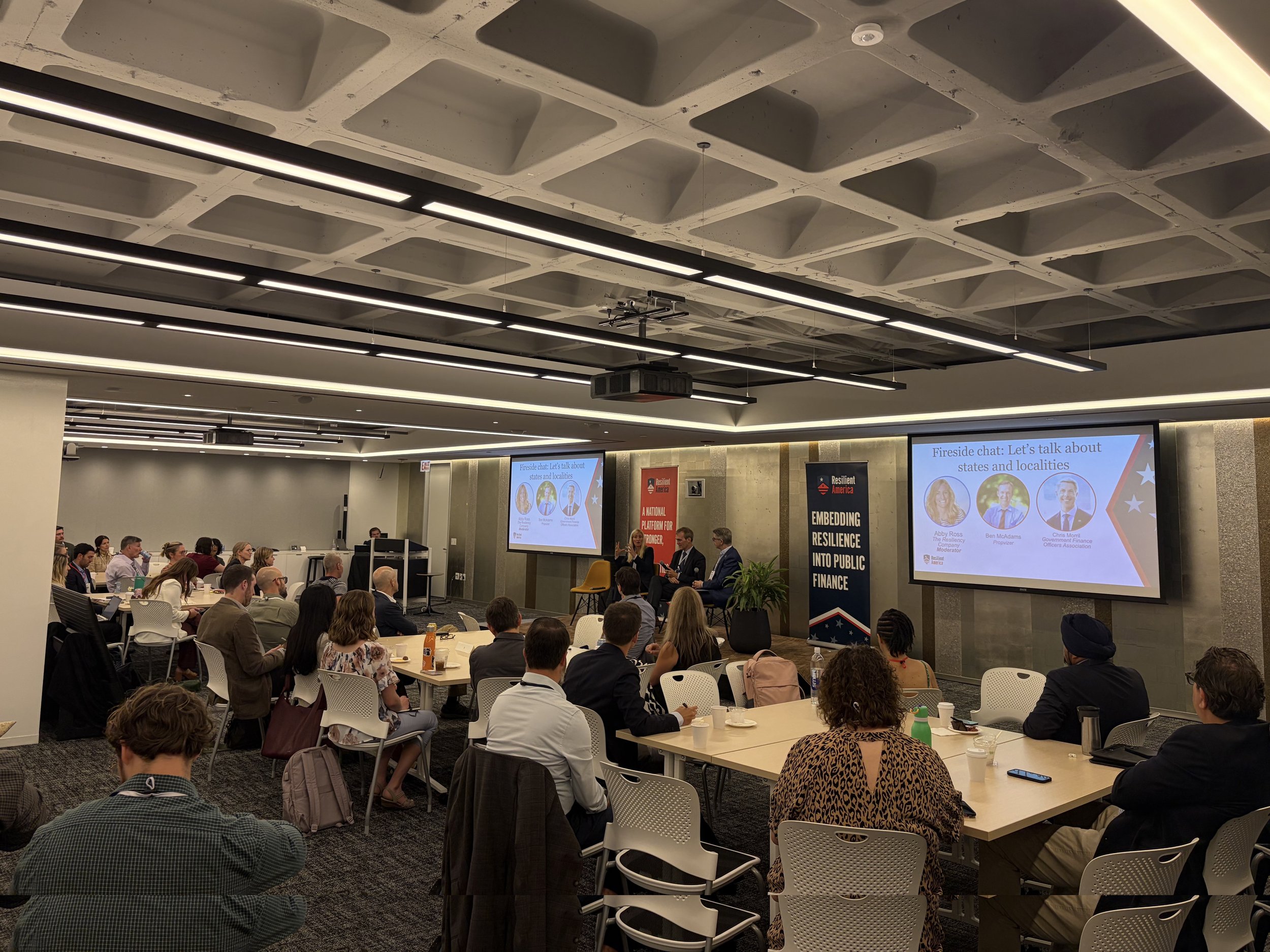
On July 23, Resilient America brought together nearly 100 leaders from state and local government, public finance, insurance, philanthropy, infrastructure, investment, and the broader resilience ecosystem to explore a fundamental question: What will it take to move resilience from a recognized need to something communities can actually finance and deliver at scale?
Public-sector leaders brought real problems to the table. Practitioners and capital providers brought different tools and perspectives. Rather than producing a single answer, the discussions surfaced a consistent set of themes about where the resilience field needs to go next. Here are three:
1. Resilience has to become part of how governments make financial decisions.
Physical risk ultimately becomes fiscal risk—through damaged infrastructure, disrupted revenues, higher operating costs, insurance pressures, and repeated recovery spending. Yet these risks are still too often treated as resilience issues rather than financial ones.
A major theme of the Summit was the need to move resilience out of a silo and into the financial systems governments already use to manage risk and allocate capital. Matt Posner and Shayne Kavanagh of GFOA demonstrated how the RiskReserve Tool (RRT) uses Monte Carlo simulation to translate a range of future risks, including natural hazards, into potential financial losses and test those losses against a government’s reserves. This reframes reserves as a form of self-insurance rather than simply a savings account: Are reserves sufficient for the risks a government faces? Are they excessive? And could some of that capital be better deployed to reduce the underlying risk?
For some communities, that analysis has identified reserve capacity beyond what modeled risks require, opening a conversation about whether capital could be redirected toward risk reduction. The larger opportunity is to make resilience part of ordinary public finance—where physical risk is quantified in financial terms and considered alongside the other risks governments already manage, rather than treated as a separate priority competing for scarce resources.
2. The resilience financing model is changing.
Federal, state and philanthropic grants will remain important, but communities cannot build long-term resilience strategies around grant availability alone. With federal resources less predictable and a potential 50% reduction in federal dollars to states and localities under the current administration the conversation is shifting toward public finance, insurance, private capital, and other market-oriented approaches.
North Carolina's insurer of last resort demonstrated what's possible: a $50M fortified roof program returned $67M+ in reinsurance savings and avoided losses, and an Insurance-Linked Security (ILS) resilience bond with a resilience kicker targeted $350M but closed at $600M at lower-than-expected cost. The challenge is building a clearer financial case for resilience and creating structures, such as revolving loan funds, resilience bonds, and parametric insurance, that allow different sources of capital to participate at scale.
Progress requires coordination. The math on resilience favors action,avoided losses, lower reinsurance costs, stronger credit ratings, but no single actor has the authority to move the whole system. As Xavier De Souza Briggs and I wrote in a recent Epicenter article, progress requires trust and a shared view of the problem across government, utilities, insurers, and private capital.
The tools already exist—the gap is scale. Resilience bonds, PACE financing, parametric insurance, and state revolving loan funds are all proven. But the muni bond market moves $500B/year in infrastructure capital and remains largely untapped by the resilience community. This is the —identified as low-hanging fruit. Nature-based solutions generate $6–$13 in savings per $1 invested, but the investor rarely captures that return directly—a structural policy misalignment that financing innovation alone cannot fix.
Nonprofit and public delivery models are essential. Private capital’s return requirements compete directly with dollars that could otherwise go to projects. The Resilience Authority of Annapolis—the first multi-jurisdictional resilience authority in the country—shows what that difference looks like in practice: independent of government procurement rules, $0.94 of every dollar goes directly to projects, with the ability to blend philanthropic, federal, and private capital in a single transaction.
3. Resilience is a team sport—but the government is at the center.
No single institution can solve community risk alone. The Summit's core diagnosis was that resilience is a coordination problem, not a cost-benefit problem. No single actor has authority to move the whole system.
Governments, public finance professionals, insurers, investors, philanthropy, nonprofits, developers, engineers, and other partners each bring different tools to the table—as Escondido showed by partnering with a developer and IBHS to create Dixon Trail, the country's first certified wildfire-prepared neighborhood, which cut insurance costs from a projected $8–10K/year to $1,200/year.
State and local governments are uniquely positioned to convene that ecosystem because they own assets, set policy, allocate capital, and ultimately bear many of the consequences when risks materialize.
Where We Go From Here
The clearest takeaway from the Summit was that resilience needs both a common financial starting point and a team around the table.
We need to move beyond asking simply, How do we fund this project? and start asking, What financial risk does this community face, what outcomes could change that trajectory, and how should we invest accordingly? The RiskReserve Tool (RRT) provides a starting point: a common dataset that translates a community’s risks into potential liabilities through the lens of the government budget.
Then comes the work that Summit participants valued most: bringing governments together with public finance, philanthropy, nonprofits, insurers, investors, and practitioners in a trusted setting to work through their specific challenges and identify solutions. Start with the risk. Put a team around it. Build toward outcomes that improve both community resilience and fiscal resilience.
That is the model we want to proliferate through Resilient America. Join the Resilient America network to stay involved as we bring this approach to more communities.
Note to readers: Chatham House rules applied to the entire Summit. Named organizations were used only when the information has been made public and the entity agreed.
The Resilient America Summit Program
July 23, 2026
Chicago, IL
Venue:
IIDA IDEA Studio Event Space
111 E. Wacker Drive
